In Senegal, sardinella is dinner. In Peru, anchoveta underpins one of the world’s most productive marine ecosystems. In the Philippines, sardines are a staple food passed down through generations.
These small pelagic fish matter to people all over the world. They are among the most important sources of protein for coastal communities, the backbone of many small-scale fisheries, a key part of many marine ecosystems, and at the heart of many cultures.
Given all that, you’d expect most of these fish to go toward feeding people directly. But not all are making it to a plate; at least not in the way you might think.
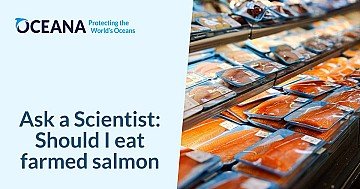
Instead, they are caught, ground up, and shipped far away, not to feed people directly, but to feed farmed fish and shellfish including salmon, seabass, and shrimp.
How are Fishmeal and Fish Oil Made?
Every year, nearly 20 million tons of wild fish are turned into fishmeal or fish oil.
Fleets of industrial fishing boats scour the waters off Peru, West Africa, and South Asia, pulling in huge amounts of small pelagic fish like sardines and anchovies. The fish are then taken to processing plants where they undergo a dramatic transformation.
The catch is cooked at high temperatures before being pressed to squeeze out the liquids, a mixture of water and oil. By this point, fish are no longer recognizable as fish, aside from their smell, perhaps. The oil is separated and purified, becoming fish oil. The solids are shredded, dried, and ground into a coarse brown powder called fishmeal.
Fishmeal and fish oil are then shipped around the world. Some are used in human supplements, pet food, and livestock feed. But most are used to feed farmed fish and shellfish.
This is a global industry. Much of the world’s fishmeal and fish oil is produced in Peru, Chile, Vietnam, India, and China. China is also the world’s largest user of fishmeal. In fact, it uses more than 40% of the fishmeal made around the world. Meanwhile, Norway and Chile are the biggest fish oil users.
As the carnivorous aquaculture industry expands, so does its dependence on fishmeal and especially fish oil.
And that comes at a steep cost.
What Are the Environmental Impacts of Fishmeal and Fish Oil Production?
Small pelagic fish – the kind used to make fishmeal and fish oil – have one of the lowest carbon footprints of any fish or shellfish, whether farmed or wild. But when these fish are caught, processed, shipped around the world, and turned into feed for other animals, their environmental footprint grows.
Fishmeal and fish oil factories are a major source of air and water pollution. For nearby communities, it can permeate nearly every aspect of daily life.
From Senegal to Peru, people have described the stench from nearby factories as nauseating. Black smoke hangs in the air. Soot settles on homes. Untreated waste pollutes the surrounding water systems.
The factories are only one part of the problem. The growing demand for fishmeal and fish oil can also drive overfishing, depleting local fish populations and disrupting food webs. When too many wild fish are caught by industrial fleets, small-scale fishers risk coming to shore with near-empty nets. For coastal communities, that can make it harder to access a key source of protein.
How Does the Fishmeal and Fish Oil Industry Affect Coastal Communities?
The costs of turning fish into feed are felt far beyond the water. When fish that could feed people are turned into fishmeal and fish oil instead, coastal communities can lose access to food, livelihoods, land, and more.
In 2020, up to 144,000 tons of small pelagic fish from the coast of West Africa were used to produce fish oil for the Norwegian salmon industry. That same amount of fish could have provided up to 4 million West Africans with enough fish to meet their recommended daily intake for a year.
That is a lot of fish that could have helped feed people but instead was turned into feed for farmed fish.
In Gunjur, a town in The Gambia, women who processed and smoked fish for a living were pushed off the land they had used for generations to make way for a new fishmeal factory. Today, that plant pollutes the same land and water the community once depended on.
A similar story has played out in Peru, though it goes back further in time. For thousands of years, anchoveta was a key protein source for Peruvian civilizations. But over the past 75 years or so, the tradition of eating anchoveta has been lost.
This was largely a result of the industrialization of the fishery and the change in perception from anchoveta as a food fish to anchoveta as the main ingredient for fishmeal – something stinky, oily, and cheap, not fit for human consumption. Over time, a food that was once central to Peruvian life became mostly an export commodity.
When fish become harder to find and fishing jobs disappear, the consequences reach far beyond lost income. For some fishers, losing their livelihoods can mean leaving their homes, families, and communities behind.
In the most devastating cases, people risk their lives to search for work.
In 2024, thousands of people from Senegal and other West African countries made the dangerous journey to Spain’s Canary Islands in search of work. Tragically, an estimated 10,000 people went missing at sea and never reached their destination. This is a humanitarian crisis. Behind these numbers are real people who left their homes in search of a way to support themselves, their families, and their communities.
Often the people most affected by this industry, from small-scale fishers to local fish processors to entire coastal towns, have the least say in how it’s run. This isn’t simply a story about food versus feed; it’s about equity and justice.
Can Aquaculture Reduce its Reliance on Wild Fish?
Aquaculture can be part of a sustainable food system, but only if it doesn’t come at the expense of people and ecosystems.
Small-scale fishers should have first access to the fish off their own coasts, not large industrial fleets that export to other countries. Protecting small-scale fishers’ human rights and their access to land, sea, and markets is crucial for both equity and sustainability.
Low-impact, small-scale aquaculture can help create a fairer food system. This includes growing seaweed, oysters, mussels, clams, and scallops. It can even include some fish that are raised without any fishmeal or fish oil.
A better system is possible, but reform must begin with recognizing fish as food, not feed.
The information and case studies used in this blog come from a recent scientific paper in Frontiers led by scientists from Oceana, Queen Mary University of London, Norwegian Institute for Water Research, University of British Columbia, University of Bonn, and an independent investigator from The Gambia.