An article published in “El Confidencial“, October 2025.
WtEnergy Advanced Solutions’ synthetic gas stands out as an effective alternative to traditional fuels and fossil resources. In 2023, the company recorded revenues of €700,000; last year, €7 million; and it now expects to close 2025 with €20 million.
This Catalan startup has managed to bring together key requirements through an innovative process that converts solid waste into gas for industrial purposes. Its “philosopher’s stone” lies in biomass and fuels derived from waste. “It’s about decarbonizing industry through technologies that convert any combustible waste into a high-quality synthetic gas—or Syngas—a clean, renewable gas that can be used across various industries,” explains Andrés Ponce, CEO of WtEnergy Advanced Solutions, from the company’s offices in Poblenou, the Barcelona district known for its cluster of tech firms and startups.
Since 2002, Andrés—a mechanical engineer by training—has worked on gasification projects focused on decarbonization. “But the market wasn’t ready for these concepts yet,” he recalls. In 2017, alongside his partner Antonio Crous, he founded his own company, drawing on years of thermo-chemical experience. They started with three people. In 2023, revenue reached €700,000; last year, €7 million; and by 2025, they expect €20 million. Today, the company employs 20 people—and all thanks to waste.
These wastes include end-of-life tires; wood chips from forestry operations and sawmill residues; old furniture remains (so-called demolition wood waste); agricultural and livestock residues that are often burned; paper industry discards; and the non-recyclable fraction of municipal solid waste that usually ends up in landfills or incinerators.
“Each of us generates around 1.6 kg of waste per day. In Spain, 45% of that still goes to landfill or incineration because recycling technologies only go so far. What we propose is to turn waste into a resource—thanks to circularity—giving these materials a second life and energy value,” says Ponce.
Goodbye to fossil fuels
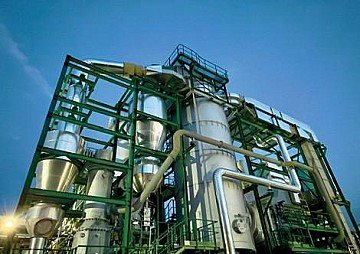
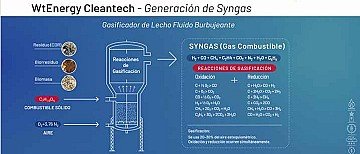
The technology used to provide this second life is called bubbling fluidized bed gasification, carried out in a reactor that converts biomass and waste-derived fuels into Syngas through a thermo-chemical process at very high temperatures—between 700 and 800°C. The resulting Syngas can be used for various applications, such as industrial heat or energy. In sectors like food, paper, or chemicals, heat can play a critical role.
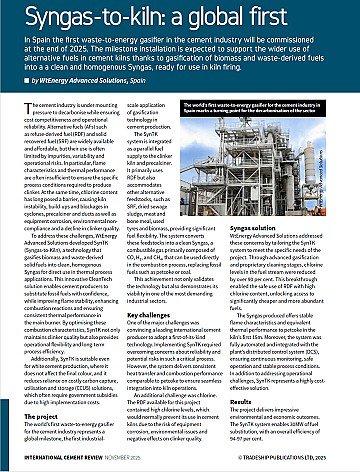
Another application for Syngas is in kilns: in industries like cement, it can replace petroleum coke in high-temperature furnaces, significantly reducing the carbon footprint. It can also power engines or turbines for energy generation or be used in highly efficient cogeneration systems with heat recovery.
Moreover, Syngas can be refined into other energy vectors. Through purification processes, it can become a source of green hydrogen or be transformed into products like methanol, ammonia, or SAF (sustainable aviation fuel)—opening the door to a sustainable, waste-based chemical industry. Compared to biomass boilers, this technology offers more versatile applications, lower emissions, greater energy efficiency, and better waste valorization, since it produces useful by-products that would otherwise be discarded.
“Syngas is, in the short term, a solution for immediate industrial decarbonization—and in the long term, a path to energy stability.”
“Our main clients are industries with high energy consumption—for instance, the cement sector, which requires very high process temperatures. This industry is responsible for 8% of global emissions, and today there aren’t many alternatives to fossil fuels to meet that heat demand. With our gasification process, it’s possible to increase the rate of fossil fuel substitution with alternatives. Another sector we work with is the animal by-product industry, which also needs to burn residues at high temperatures. And the paper industry, which can use the gas generated through our technology for its production process,” the CEO explains.
He continues: “Syngas, in the short term, is a powerful complementary solution for immediate (and affordable) industrial decarbonization. And in the long term, industries aiming for sustainability must free themselves from fossil fuel dependency—and those seeking energy stability as well. If tomorrow Russia destabilizes the energy market again, industry will inevitably be affected.”
The Catalan company has two ways of commercializing its syngas: selling the equipment directly to the client and building an on-site plant, or co-investing with partners in gasification facilities to sell steam directly to the end customer. “We already have projects across Europe, and taking on new ones will depend on the partners we find, both here and abroad. Keep in mind, these are large-scale projects worth between eight and ten million euros each.
They require significant deployment and investment. One of the most important supports we’ve received has been from Banco Santander, to whom we are deeply grateful for their trust.”
To aspiring entrepreneurs, the CEO of this cleantech company advises: “Be consistent, persistent, and patient—because everything will come if your idea is good, even if it means spending years struggling to make it happen. In my case, I’ve always lived on the edge, just three months ahead. Fortunately, that risk is now gone; we’re fully stable, with positive EBITDA and growing at a strong pace.”